 Jian Yi-Hong Solitud II
Post date:2026-07-14
Updates:2026-07-14
6
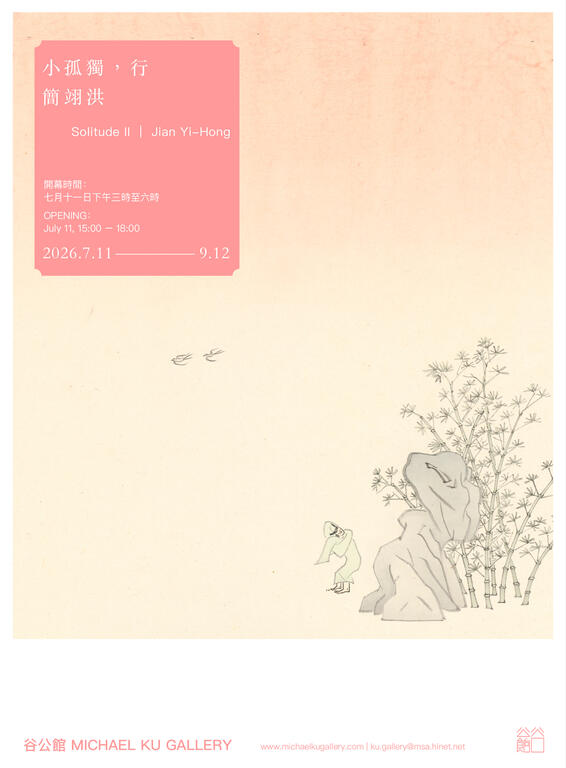
- Event Time
- 2026-07-11~2026-09-1211:00-19:00 Tue. to Sat.
- Organizer
- michael ku gallery
- Phone Number
- 02-25775601
- FAX
- 02-25775602
- Event Location
- 4F.-2, No. 21, Sec. 1, Dunhua S. Rd.(michael ku gallery), Songshan Dist., Taipei City Taiwan, R.O.C
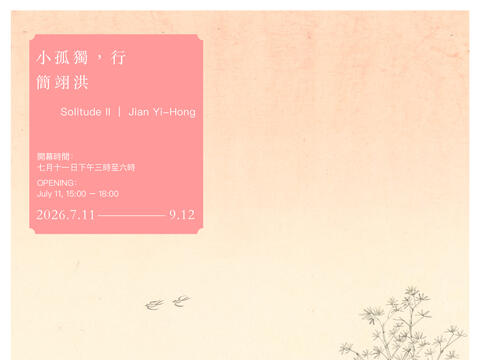
Michael Ku Gallery is pleased to announce Jian Yi-Hong's solo exhibition, "Solitude II", which serves as the sequential second part following his previous exhibition, ''Solitude''.
While the previous exhibition, ''Solitude'', showcased entirely new creations from the past two years—reflecting how the artist completed each piece through a process of self-communion—the upcoming ''Solitude II'' gathers a selection of 33 definitive works spanning from 2010 to 2024. This collection includes works on paper and silk, handscrolls, thread-bound albums, and screens. Audiences will witness the core of Jian Yi-Hung's creative journey over the past decade, as well as the natural evolution of his painting style shaped by aging, shifting states of mind, and technical challenges. It is a path of continuous personal progression.
Looking back at Jian's past exhibitions at Michael Ku Gallery—including ''Let Us not be Sad Anymore'' (2016), ''AMOUR - Love Wholeheartedly '' (2019), and ''La Dolce Vita'' (2022)—each title chosen by the artist feels like a footnote to a specific phase of his real life. Although the figures Jian paints have possessed a highly distinctive, stylized appearance from the very beginning, his practice is actually the antithesis of mere graphic stylization; instead, he seeks to navigate and debate the authentic emotions of his inner world. Rather than adopting a grand narrative perspective, even when depicting Miaoyu—the tonsured nun from the classic novel ''Dream of the Red Chamber''—in his handscroll ''Miaoyu'', it feels more like a close-up self-gaze, meticulously observing the fleeting fragments of life. Jian's brushwork and palette are remarkably clean, yet he often wrestles with a line that isn't perfectly executed or a color that fails to come through. Much like his erotic narratives, his work courageously articulates deep-seated desires for love and lust, yet remains extraordinarily pristine—imbued with a nearly fastidious conviction.
The earliest pieces in the exhibition date back to Jian 's university years. During this period, he completed ''It's so Good that I Can See Your Penies in My Dream'' . Using a drawing board salvaged from recyclables, the artist wrapped it layer by layer with Xuan paper he had on hand. He then coated the surface multiple times with a traditional sizing solution made from raw alum purchased at a Chinese herbal medicine shop, transforming it into a paintable canvas. It was an age when the artist was brimming with sexual fantasies; the imagery is raw and direct, attempting to fuse meticulous Gongbi lines and sketching brushwork with his personal way of seeing. Through this, he found a balance between the ancient, classic atmosphere of ink painting and contemporary individual imagination.
Subsequently, he completed ''Tears are Pearls'' and ''Tears are Lakes''. These two works were painted using a mixture of acrylic paint, ink, and starch paste. On the cusp of graduating from university—a period filled with anxiety and uncertainty about the future—painting became a way to channel his emotions. He gradually realized that creation is not merely a reproduction of the external world, but a profound expression of the inner self. Later, adjusting his choice of substrate, he utilized Chanyi Xuan paper from the historic Rongbaozhai to complete works like ''The Hunting Ground in Winter'' and ''Flight 116'' , candidly presenting audiences with various fantasy stories projected from his emotions. Of course, these works are more than just emotional projections; they also contain the vocabulary and symbols of his future creations. Figures, animals, water surfaces, plants, and stage-like spatial arrangements all began to take shape during this period.
In his youth, emotional setbacks were translated into paintings, resulting in works such as ''Condolence'', ''Hanging String Lights'', and ''Ward Life''. The figures in these frames often appear restrained, stagnant, or soul-bereft. Such highly delicate expressions were frequently rendered on silk. In contrast to paper, the artist opts for silk when he requires finer lines and subtler tonal gradations.
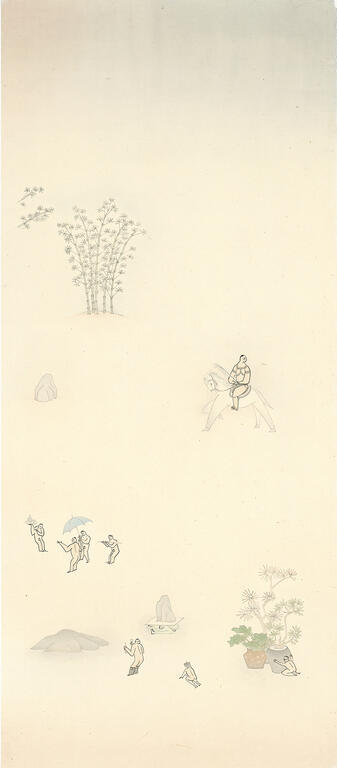
By the time of his solo exhibition ''AMOUR - Love Wholeheartedly'', Jian had found a sense of clarity through several experiences of romantic love. Works like ''Colorful, Aromatic, and Tasty'', ''Sword Dance'', and ''Leaning on a Table and Forgetting Words'' were born during this period, viewing life with a touch of humor. At this stage, the artist pondered the lines of his brush, exploring how ink lines themselves could convey various nuanced observations. During this time, he also experimented with new ideas in mounting formats: various fan-shaped cut-outs, window views, scrolls, hanging scrolls, and small booklets began to emerge sequentially. Between 2019 and 2023, he completed a series of five thread-bound booklets titled ''Book of Desire'', which compiled sketches and jottings from his notebooks that were difficult to develop into standalone paintings. However, through the format of a small book, flipping through them offers a new way of viewing, turning them into a readable discourse.
In 2020, collaborating with a theater troupe for the handscroll ''Miaoyu'', Jian attempted to sketch with a calligraphy brush while the paper was still raw, deliberately preserving the traces of the ink lines, and only applied color after treating the paper with alum sizing. In the center of the composition, amidst a plantain garden, he placed sculptures by Henry Moore alongside female nudes reminiscent of Sanyu's style. These artists' representations of the body have always been subjects of Jian 's observation and study, and he used these bodily motifs to hint at the awakening desires within Miaoyu.
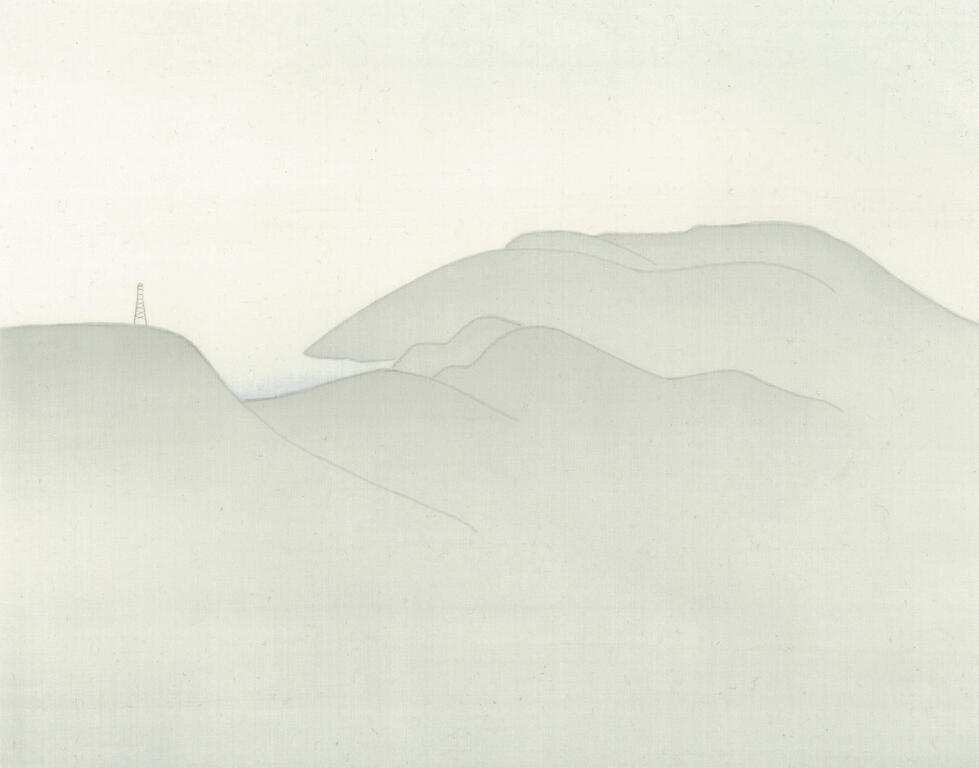
Compared to his earlier focus on narrative detail, during the 2021 pandemic, Jian began to care more about the rhythm within the composition and the independent wholeness of the painted frame. His lines shifted from the earlier tight "iron-wire descriptions" to a more flexible use of brush feel, changing the tempo of his strokes and the density of the ink according to the objects or subjects being depicted. The overall tone no longer deliberately chased an antique simplicity, but moved closer to a modern clarity. He experimented with layering pigments like Suihi pigment (water-based pigments) and mineral colors, allowing the spatial depth inherent in the painting materials themselves to shine through. Consequently, modern interior spaces, daily objects, smartphone-captured perspectives, and travel memories gradually entered his canvas. The works also began to portray perceived life states from a more neutral, rational creative angle.
The 2024 screen piece, ''Storms and Serenity'', serves as a comprehensive summation of a certain creative stage. Jian arranges novelistic stories—set on the sun-drenched Shalun beach from his past explorations and imaginations—into a standing wooden screen structure, adopting a perspective that is simultaneously an active participant and an detached onlooker. The figures within are a collection of his various explorations of desire over the past decade or so: flirting, submitting, or walking away in indifference toward their own directions, finding contentment somewhere between a lighthearted, mutual promise of a lifetime and the grave of love.
Along the lonely path of art, there are still moments of serendipity that accompany us all the way. Special thanks go to Green Rain Studio (Ching Yu Shan Fang), who has tailor-made the framing and mounting for Jian Yi-Hong's artwork for over a decade, as well as the friends who have continuously supported him through the years. Jian Yi-Hong's work presents scenes of raw, undisguised human nature—yet ultimately, it is all rooted in love.
While the previous exhibition, ''Solitude'', showcased entirely new creations from the past two years—reflecting how the artist completed each piece through a process of self-communion—the upcoming ''Solitude II'' gathers a selection of 33 definitive works spanning from 2010 to 2024. This collection includes works on paper and silk, handscrolls, thread-bound albums, and screens. Audiences will witness the core of Jian Yi-Hung's creative journey over the past decade, as well as the natural evolution of his painting style shaped by aging, shifting states of mind, and technical challenges. It is a path of continuous personal progression.
Looking back at Jian's past exhibitions at Michael Ku Gallery—including ''Let Us not be Sad Anymore'' (2016), ''AMOUR - Love Wholeheartedly '' (2019), and ''La Dolce Vita'' (2022)—each title chosen by the artist feels like a footnote to a specific phase of his real life. Although the figures Jian paints have possessed a highly distinctive, stylized appearance from the very beginning, his practice is actually the antithesis of mere graphic stylization; instead, he seeks to navigate and debate the authentic emotions of his inner world. Rather than adopting a grand narrative perspective, even when depicting Miaoyu—the tonsured nun from the classic novel ''Dream of the Red Chamber''—in his handscroll ''Miaoyu'', it feels more like a close-up self-gaze, meticulously observing the fleeting fragments of life. Jian's brushwork and palette are remarkably clean, yet he often wrestles with a line that isn't perfectly executed or a color that fails to come through. Much like his erotic narratives, his work courageously articulates deep-seated desires for love and lust, yet remains extraordinarily pristine—imbued with a nearly fastidious conviction.
The earliest pieces in the exhibition date back to Jian 's university years. During this period, he completed ''It's so Good that I Can See Your Penies in My Dream'' . Using a drawing board salvaged from recyclables, the artist wrapped it layer by layer with Xuan paper he had on hand. He then coated the surface multiple times with a traditional sizing solution made from raw alum purchased at a Chinese herbal medicine shop, transforming it into a paintable canvas. It was an age when the artist was brimming with sexual fantasies; the imagery is raw and direct, attempting to fuse meticulous Gongbi lines and sketching brushwork with his personal way of seeing. Through this, he found a balance between the ancient, classic atmosphere of ink painting and contemporary individual imagination.
Subsequently, he completed ''Tears are Pearls'' and ''Tears are Lakes''. These two works were painted using a mixture of acrylic paint, ink, and starch paste. On the cusp of graduating from university—a period filled with anxiety and uncertainty about the future—painting became a way to channel his emotions. He gradually realized that creation is not merely a reproduction of the external world, but a profound expression of the inner self. Later, adjusting his choice of substrate, he utilized Chanyi Xuan paper from the historic Rongbaozhai to complete works like ''The Hunting Ground in Winter'' and ''Flight 116'' , candidly presenting audiences with various fantasy stories projected from his emotions. Of course, these works are more than just emotional projections; they also contain the vocabulary and symbols of his future creations. Figures, animals, water surfaces, plants, and stage-like spatial arrangements all began to take shape during this period.
In his youth, emotional setbacks were translated into paintings, resulting in works such as ''Condolence'', ''Hanging String Lights'', and ''Ward Life''. The figures in these frames often appear restrained, stagnant, or soul-bereft. Such highly delicate expressions were frequently rendered on silk. In contrast to paper, the artist opts for silk when he requires finer lines and subtler tonal gradations.
By the time of his solo exhibition ''AMOUR - Love Wholeheartedly'', Jian had found a sense of clarity through several experiences of romantic love. Works like ''Colorful, Aromatic, and Tasty'', ''Sword Dance'', and ''Leaning on a Table and Forgetting Words'' were born during this period, viewing life with a touch of humor. At this stage, the artist pondered the lines of his brush, exploring how ink lines themselves could convey various nuanced observations. During this time, he also experimented with new ideas in mounting formats: various fan-shaped cut-outs, window views, scrolls, hanging scrolls, and small booklets began to emerge sequentially. Between 2019 and 2023, he completed a series of five thread-bound booklets titled ''Book of Desire'', which compiled sketches and jottings from his notebooks that were difficult to develop into standalone paintings. However, through the format of a small book, flipping through them offers a new way of viewing, turning them into a readable discourse.
In 2020, collaborating with a theater troupe for the handscroll ''Miaoyu'', Jian attempted to sketch with a calligraphy brush while the paper was still raw, deliberately preserving the traces of the ink lines, and only applied color after treating the paper with alum sizing. In the center of the composition, amidst a plantain garden, he placed sculptures by Henry Moore alongside female nudes reminiscent of Sanyu's style. These artists' representations of the body have always been subjects of Jian 's observation and study, and he used these bodily motifs to hint at the awakening desires within Miaoyu.
Compared to his earlier focus on narrative detail, during the 2021 pandemic, Jian began to care more about the rhythm within the composition and the independent wholeness of the painted frame. His lines shifted from the earlier tight "iron-wire descriptions" to a more flexible use of brush feel, changing the tempo of his strokes and the density of the ink according to the objects or subjects being depicted. The overall tone no longer deliberately chased an antique simplicity, but moved closer to a modern clarity. He experimented with layering pigments like Suihi pigment (water-based pigments) and mineral colors, allowing the spatial depth inherent in the painting materials themselves to shine through. Consequently, modern interior spaces, daily objects, smartphone-captured perspectives, and travel memories gradually entered his canvas. The works also began to portray perceived life states from a more neutral, rational creative angle.
The 2024 screen piece, ''Storms and Serenity'', serves as a comprehensive summation of a certain creative stage. Jian arranges novelistic stories—set on the sun-drenched Shalun beach from his past explorations and imaginations—into a standing wooden screen structure, adopting a perspective that is simultaneously an active participant and an detached onlooker. The figures within are a collection of his various explorations of desire over the past decade or so: flirting, submitting, or walking away in indifference toward their own directions, finding contentment somewhere between a lighthearted, mutual promise of a lifetime and the grave of love.
Along the lonely path of art, there are still moments of serendipity that accompany us all the way. Special thanks go to Green Rain Studio (Ching Yu Shan Fang), who has tailor-made the framing and mounting for Jian Yi-Hong's artwork for over a decade, as well as the friends who have continuously supported him through the years. Jian Yi-Hong's work presents scenes of raw, undisguised human nature—yet ultimately, it is all rooted in love.