 Lin I-Tsen Solo Exhibition: A Twig on the Ground is Not Part of the Nest
Post date:2026-07-16
Updates:2026-07-16
4
- Event Time
- 2026-06-30~2026-08-16Closed on Mondays 11:00 - 18:00
- Organizer
- KING CAR CULTURAL & ART CENTER
- Phone Number
- 0225959650
- Event Location
- No. 131, Sec. 3, Chengde Rd., Datong Dist., Taipei City Taiwan, R.O.C
Many creative practices begin with looking, yet Lin I-Tsen's works seem less concerned with looking itself than with holding perception in place.
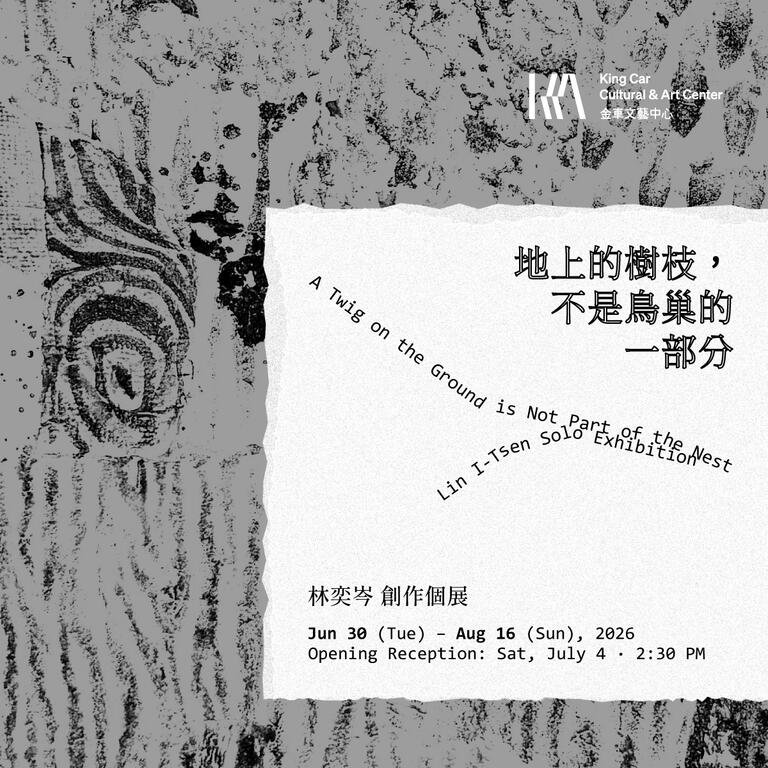
Covered in charcoal powder and fibers, the images do not rush to reveal anything. Folds, cracks, sedimentation, and layers of oxidation overlap, placing the work somewhere between the afterimage of a landscape and an organic surface. Standing before these works, one’s gaze naturally comes to rest on the subtle textures. Rather than searching for forms, one simply looks. More than depicting the subject itself, Lin is concerned with how perception can be retained within matter.
In recent years, she has continued to move toward the source of materials. Touch, weight, sedimentation, and fiber are words that recur when speaking about her practice. The image is secondary. What Lin truly seeks to understand is how materials experience time, and how the body responds when it comes into contact with matter. Her works do not offer grand narratives, nor do they provide symbolic meanings. Instead, they allow materials to slowly reveal the traces of time on their own.
From Viewing Landscape to Returning to the Source of Materials
Many years ago, in the giant tree forest of Alishan, light filtered through the woods while the trees stood against the light, leaving almost nothing but dark silhouettes. Lin recalls that this was the first time she so clearly felt how small and fleeting human beings are in the presence of nature. It was not a dramatic revelation, but rather an afterimage imprinted in her mind, lingering long after the moment had passed. Looking back, Lin realized that her works had always circled around this feeling: those indescribable moments that remain in the body for a long time. She did not seek to depict the landscape itself, but to preserve the perception that arose from it.
To capture these perceptions, she chose charcoal as her medium. Its gray-black tones recalled the deep silhouettes of the backlit forest, while charcoal itself originates from plants. This material connection allowed her to move beyond simple landscape depiction and toward the preservation of perception itself. Lin began collecting fallen branches and burning them into charcoal sticks. She also tore up old documents and letters from everyday life, turning them into pulp and remaking them into paper. These fragments, once forgotten in daily life, returned to her works in another form after undergoing transformation.
Behind this shift was her reflection on her previous approach to painting. Confronted with the blank surface, she once felt a sense of rupture. It was not a doubt about technique, but a realization that the habits she had long followed were gradually blurring her motivation to create. Within this cycle, she found that she had lost her connection with the works beneath her hand, as if she were standing outside the role of the creator, experiencing a profound sense of disconnection. This confusion over ''why one paints'' built a wall between the work and the artist, forming a lack that was difficult to fill.
She then began to ask herself: if the source of creation could be built by her own hands, could that bodily connection fill the indescribable emptiness within? Lin therefore decided to begin again from the very start. From gathering fallen branches to firing them into charcoal, from collecting paper to breaking it down into pulp, each step was slow and time-consuming. Yet this was not simply labor for its own sake, but a ritual-like restart. It was precisely through this slow and repetitive process that the relationship between herself and her works gradually came back into focus.
What fascinates her is not transforming materials into something else, but allowing those fragments left behind by everyday life to continue existing in another way. Branches become charcoal, yet the traces of plant life remain; wastepaper is broken down into pulp, yet the weight of daily life is still retained. For Lin, what truly matters is this sense of ''continuance.''
Re-sensing Time and the Body Through Repetitive Labor
Lin describes her works as ''recording time like skin,'' and this is not merely a metaphor. As paper pulp dries and accumulates, oxidation and folds naturally emerge. Charcoal powder slowly settles within it, and the material changes as time passes. The fibrous textures resemble the lines of human skin, engraving the passage of time within them. She does not see the work simply as an extension of the body, but rather as a form of ''coexistence.'' In the moment of creation, the force of the hand, the pressure of fingerprints, and the traces left by the body's shifting center of gravity all appear upon the material. These are not intentional marks, but traces left behind through prolonged labor, together with time.
Gradually, her focus shifted from visual depiction to the material itself: the tactile quality of paper fibers, the delicate powderiness of charcoal, and those subtle sensations that have not yet solidified into language and can only be perceived through the body. Composition is no longer the point of departure. Instead, intuition guides bodily movement. Regarding the cracks, sedimentation, and accidental traces that frequently appear in her works, Lin does not see them as a relinquishing of control, but as an ongoing test of material possibilities between intervention and letting go. These uncontrollable variables give the works a life-like quality, as if they remain in a state of continuous growth and becoming.
When Image Recedes, Matter Begins to Speak
Lin mentions Eva Hesse's Aught as a profound influence on her practice. The work, a dark, leather-like plane suspended on the wall, carries traces of folds and oxidation across its surface. It appears at once like a painting and a sculpture, and its strong material presence resonated deeply with Lin. Through this work, she came to realize that matter itself possesses the ability to convey its own internal language. What she had long been doing had already moved beyond painting in the traditional sense. It was more like an event in which time, material, and perception occur simultaneously.
Throughout Lin's practice, ''time'' has always been a central axis. In her early works, she attempted to capture moments beyond the everyday through the depiction of plants, light, and shadow. Now, she has turned toward allowing time to manifest through the transformation of materials, making time an inevitable part of material formation. In this process of change, her creative form has extended from visual depiction to an exploration of material and bodily perception. The work is no longer merely a visual presentation, but a field of coexistence with matter.
Standing before Lin I-Tsen's works, one encounters a feeling that is difficult to put into words. They seem like condensations formed after time has slowly settled, and also like living beings still in the midst of becoming. They are quiet, yet something within them seems to be moving.
After all this labor, dismantling, and reconstruction, what the artist seeks to confirm is, in fact, something very fundamental: how can human beings reestablish their connection with the world?
Covered in charcoal powder and fibers, the images do not rush to reveal anything. Folds, cracks, sedimentation, and layers of oxidation overlap, placing the work somewhere between the afterimage of a landscape and an organic surface. Standing before these works, one’s gaze naturally comes to rest on the subtle textures. Rather than searching for forms, one simply looks. More than depicting the subject itself, Lin is concerned with how perception can be retained within matter.
In recent years, she has continued to move toward the source of materials. Touch, weight, sedimentation, and fiber are words that recur when speaking about her practice. The image is secondary. What Lin truly seeks to understand is how materials experience time, and how the body responds when it comes into contact with matter. Her works do not offer grand narratives, nor do they provide symbolic meanings. Instead, they allow materials to slowly reveal the traces of time on their own.
From Viewing Landscape to Returning to the Source of Materials
Many years ago, in the giant tree forest of Alishan, light filtered through the woods while the trees stood against the light, leaving almost nothing but dark silhouettes. Lin recalls that this was the first time she so clearly felt how small and fleeting human beings are in the presence of nature. It was not a dramatic revelation, but rather an afterimage imprinted in her mind, lingering long after the moment had passed. Looking back, Lin realized that her works had always circled around this feeling: those indescribable moments that remain in the body for a long time. She did not seek to depict the landscape itself, but to preserve the perception that arose from it.
To capture these perceptions, she chose charcoal as her medium. Its gray-black tones recalled the deep silhouettes of the backlit forest, while charcoal itself originates from plants. This material connection allowed her to move beyond simple landscape depiction and toward the preservation of perception itself. Lin began collecting fallen branches and burning them into charcoal sticks. She also tore up old documents and letters from everyday life, turning them into pulp and remaking them into paper. These fragments, once forgotten in daily life, returned to her works in another form after undergoing transformation.
Behind this shift was her reflection on her previous approach to painting. Confronted with the blank surface, she once felt a sense of rupture. It was not a doubt about technique, but a realization that the habits she had long followed were gradually blurring her motivation to create. Within this cycle, she found that she had lost her connection with the works beneath her hand, as if she were standing outside the role of the creator, experiencing a profound sense of disconnection. This confusion over ''why one paints'' built a wall between the work and the artist, forming a lack that was difficult to fill.
She then began to ask herself: if the source of creation could be built by her own hands, could that bodily connection fill the indescribable emptiness within? Lin therefore decided to begin again from the very start. From gathering fallen branches to firing them into charcoal, from collecting paper to breaking it down into pulp, each step was slow and time-consuming. Yet this was not simply labor for its own sake, but a ritual-like restart. It was precisely through this slow and repetitive process that the relationship between herself and her works gradually came back into focus.
What fascinates her is not transforming materials into something else, but allowing those fragments left behind by everyday life to continue existing in another way. Branches become charcoal, yet the traces of plant life remain; wastepaper is broken down into pulp, yet the weight of daily life is still retained. For Lin, what truly matters is this sense of ''continuance.''
Re-sensing Time and the Body Through Repetitive Labor
Lin describes her works as ''recording time like skin,'' and this is not merely a metaphor. As paper pulp dries and accumulates, oxidation and folds naturally emerge. Charcoal powder slowly settles within it, and the material changes as time passes. The fibrous textures resemble the lines of human skin, engraving the passage of time within them. She does not see the work simply as an extension of the body, but rather as a form of ''coexistence.'' In the moment of creation, the force of the hand, the pressure of fingerprints, and the traces left by the body's shifting center of gravity all appear upon the material. These are not intentional marks, but traces left behind through prolonged labor, together with time.
Gradually, her focus shifted from visual depiction to the material itself: the tactile quality of paper fibers, the delicate powderiness of charcoal, and those subtle sensations that have not yet solidified into language and can only be perceived through the body. Composition is no longer the point of departure. Instead, intuition guides bodily movement. Regarding the cracks, sedimentation, and accidental traces that frequently appear in her works, Lin does not see them as a relinquishing of control, but as an ongoing test of material possibilities between intervention and letting go. These uncontrollable variables give the works a life-like quality, as if they remain in a state of continuous growth and becoming.
When Image Recedes, Matter Begins to Speak
Lin mentions Eva Hesse's Aught as a profound influence on her practice. The work, a dark, leather-like plane suspended on the wall, carries traces of folds and oxidation across its surface. It appears at once like a painting and a sculpture, and its strong material presence resonated deeply with Lin. Through this work, she came to realize that matter itself possesses the ability to convey its own internal language. What she had long been doing had already moved beyond painting in the traditional sense. It was more like an event in which time, material, and perception occur simultaneously.
Throughout Lin's practice, ''time'' has always been a central axis. In her early works, she attempted to capture moments beyond the everyday through the depiction of plants, light, and shadow. Now, she has turned toward allowing time to manifest through the transformation of materials, making time an inevitable part of material formation. In this process of change, her creative form has extended from visual depiction to an exploration of material and bodily perception. The work is no longer merely a visual presentation, but a field of coexistence with matter.
Standing before Lin I-Tsen's works, one encounters a feeling that is difficult to put into words. They seem like condensations formed after time has slowly settled, and also like living beings still in the midst of becoming. They are quiet, yet something within them seems to be moving.
After all this labor, dismantling, and reconstruction, what the artist seeks to confirm is, in fact, something very fundamental: how can human beings reestablish their connection with the world?