 Taipei Astronomical Museum's May Themed Tours: Discover the Most Beautiful Moment of Solar Eclipse—Baily's Beads
Post date:2026-05-19
Updates:2026-05-19
583
This May, Taipei Astronomical Museum's themed weekend tours will introduce visitors to one of the most astonishing moments in the course of solar eclipse—Baily's Beads. In addition to explaining how Baily's Beads are formed, the program will also guide visitors through the Moon's varied surface features, offering a closer look at the unique charm of Earth's only natural satellite. The themed tours are held on weekend mornings at 10:00 and 11:00 a.m. and afternoons at 2:00, 3:00, and 4:00 p.m. No reservation is required, and all are welcome to join.
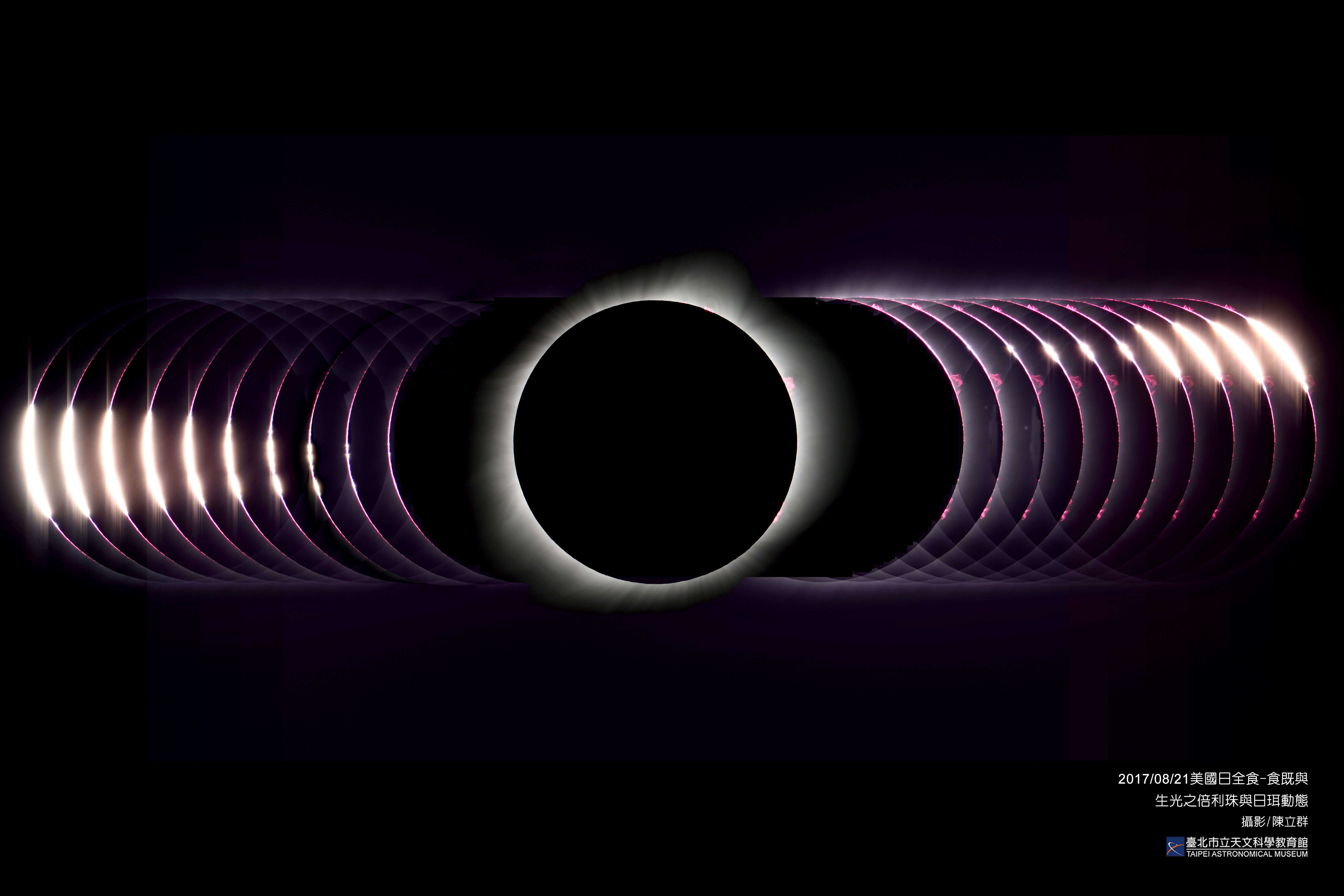
On May 15, 1836, British astronomer Francis Baily became the first to provide a scientific description of the pearl-like points of light seen during an annular solar eclipse, and the phenomenon was later named after him. This year marks the 190th anniversary of that discovery. Baily's Beads form when sunlight shines through gaps between valleys and highlands along the Moon's edge. In fact, the Moon's surface is far from flat. According to data from NASA's Lunar Reconnaissance Orbiter (LRO), the elevation difference between the highest and lowest points on the Moon can reach about 20 kilometers. It is these rises and dips in the lunar terrain that create the brilliant, fleeting spectacle of Baily's Beads.
In addition, the rooftop observatory at Taipei Astronomical Museum offers daytime observations daily from 10:00 a.m. to 12:00 noon and from 2:00 to 4:00 p.m., allowing visitors to safely observe sunspots and solar activity with professional equipment. Every Saturday from 7:00 to 9:00 p.m., the museum also holds nighttime telescope stargazing sessions. Highlights for May include Jupiter, Mizar and Alcor, the Beehive Cluster (M44), and the Moon. Visitors are welcome to experience the beauty of the early summer night sky through a telescope. For more information on exhibition hall tours and stargazing activities, please visit the Taipei Astronomical Museum website.
On May 15, 1836, British astronomer Francis Baily became the first to provide a scientific description of the pearl-like points of light seen during an annular solar eclipse, and the phenomenon was later named after him. This year marks the 190th anniversary of that discovery. Baily's Beads form when sunlight shines through gaps between valleys and highlands along the Moon's edge. In fact, the Moon's surface is far from flat. According to data from NASA's Lunar Reconnaissance Orbiter (LRO), the elevation difference between the highest and lowest points on the Moon can reach about 20 kilometers. It is these rises and dips in the lunar terrain that create the brilliant, fleeting spectacle of Baily's Beads.
In addition, the rooftop observatory at Taipei Astronomical Museum offers daytime observations daily from 10:00 a.m. to 12:00 noon and from 2:00 to 4:00 p.m., allowing visitors to safely observe sunspots and solar activity with professional equipment. Every Saturday from 7:00 to 9:00 p.m., the museum also holds nighttime telescope stargazing sessions. Highlights for May include Jupiter, Mizar and Alcor, the Beehive Cluster (M44), and the Moon. Visitors are welcome to experience the beauty of the early summer night sky through a telescope. For more information on exhibition hall tours and stargazing activities, please visit the Taipei Astronomical Museum website.


